 11
11
AI Mode in Google Search engines have changed dramatically over the past few years. Instead of simply displaying a list of blue links, modern search experiences now use artificial intelligence to understand complex questions, analyze information from multiple trusted sources, and generate detailed answers instantly.
To stay ahead in the AI race, Google introduced Google AI Mode, a new way to search that combines the power of Google’s search index with advanced generative AI. Rather than forcing users to open multiple websites to find an answer, AI Mode provides conversational, context-aware responses while still giving users access to supporting web sources.
This marks one of the biggest changes to Google AI Search since its launch. Whether you’re researching a product, planning a trip, comparing software, solving a technical problem, or learning a new skill, AI Mode is designed to make finding information faster, smarter, and more interactive.
For everyday users, this means less time searching and more time getting useful answers. For website owners, bloggers, publishers, and SEO professionals, however, AI Mode introduces a new challenge: creating content that Google’s AI considers trustworthy enough to cite in its generated responses.
As AI-powered search becomes more common in 2026, understanding how Google AI Mode works is no longer optional. It’s an essential part of modern SEO and Generative Engine Optimization (GEO).
In this guide, you’ll learn what Google AI Mode is, how it works, its major features, how it differs from traditional Google Search, and what businesses and content creators should do to remain visible in an AI-first search landscape.
AI Mode is Google’s next-generation AI-powered search experience that delivers conversational, AI Mode delivers clear, conversational answers instead of simply showing a list of traditional search results.
Unlike classic Google Search, which primarily displays a ranked list of webpages, AI Mode analyzes your question, understands its intent, searches across Google’s vast index, and generates a comprehensive response using advanced large language models (LLMs).
The experience feels similar to chatting with an AI assistant while still benefiting from Google’s real-time search capabilities.
For example, imagine searching:
“What’s the best laptop for programming under $1,500 in 2026?”
Instead of showing only product pages and review articles, AI Mode may generate a complete answer that includes:
This allows users to make faster decisions without having to visit multiple websites to gather information.
What makes Google AI Mode different is its ability to combine generative AI with Google’s live search results and trusted web content. This helps it deliver answers that are more accurate, timely, and relevant than those based only on pre-trained knowledge.
In short, AI Mode transforms Google Search from a search engine into an intelligent research assistant.
User behavior has changed significantly in recent years.
People now expect search engines to answer complex questions directly instead of making them piece together information from multiple websites.
At the same time, AI assistants have become a popular way to find information because they provide quick, easy-to-understand answers in a natural conversational style.
To meet these expectations, Google developed AI Mode with several goals:
Rather than replacing traditional Search completely, AI Mode enhances it by combining Google’s ranking systems with advanced AI reasoning capabilities.
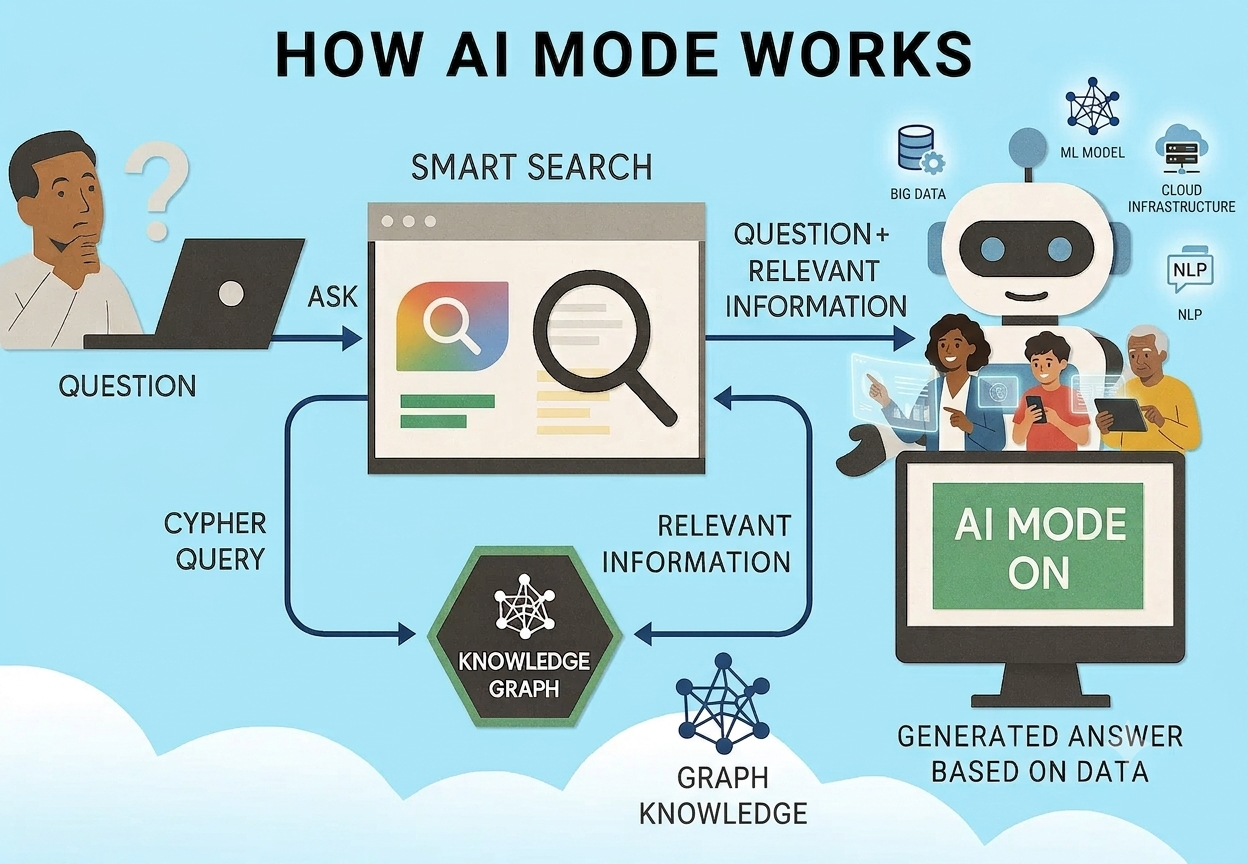
Google AI Mode combines several advanced technologies to understand your question and generate useful answers.
Instead of matching keywords alone, it performs multiple intelligent steps before presenting a response.
The first step is identifying what you’re actually asking.
Rather than focusing only on exact keywords, AI Mode interprets the meaning behind your query.
For example:
Although the wording is different, AI Mode understands that all three searches have a similar intent and delivers relevant recommendations.
This natural language understanding makes search feel more like talking to a knowledgeable expert.
After understanding the query, AI Mode searches Google’s enormous web index to collect information from trusted and relevant websites.
Instead of relying on one source, it evaluates content from multiple pages to identify consistent, high-quality information.
Google’s existing ranking systems continue to play an important role here by determining which sources are authoritative, reliable, and useful.
Once enough relevant information has been gathered, Google’s large language model analyzes the content and creates a single, easy-to-read response.
Rather than copying one article, the AI combines information from multiple trusted sources into a concise explanation that answers the user’s question.
The response may include:
This synthesis helps users understand complex topics much faster.
One of AI Mode’s biggest advantages is conversational search.
Instead of starting over with every new query, users can ask follow-up questions naturally.
For example:
User: What are the best AI image generators?
AI Mode: Provides recommendations.
User: Which one is best for beginners?
AI Mode: Narrows the comparison based on the previous conversation.
This creates a seamless research experience without repeatedly typing full search queries.
Although AI Mode generates summarized answers, it still encourages users to explore original sources.
Responses often include links to authoritative websites where users can verify information, read detailed explanations, or continue their research.
For publishers, this means high-quality, trustworthy content still has the opportunity to earn visibility and traffic—especially when it demonstrates expertise, originality, and clear value.
Google AI Mode represents the evolution of search from a keyword-based engine to an AI-powered knowledge assistant. It understands user intent, gathers information from trusted sources, synthesizes that information into clear answers, and supports natural follow-up conversations. As AI search continues to grow in 2026, creating accurate, well-structured, and authoritative content will be increasingly important for earning visibility in Google’s AI-generated responses.
Google AI Mode is much more than an upgraded search engine. It combines artificial intelligence, conversational search, and Google’s vast search index to deliver smarter and more personalized answers. Below are the features that make AI Mode one of the biggest advancements in search technology.
Unlike traditional Google Search, AI Mode allows users to interact naturally with the search engine. Instead of typing separate queries each time, users can ask follow-up questions just like they’re chatting with an AI assistant.
For example:
User: What are the best VPNs for streaming?
AI Mode: Recommends the top VPN services.
User: Which one is the fastest for Netflix?
Google understands the context of the previous question and refines its answer without requiring the user to start a new search.
Overall, this makes searching for information quicker, more convenient, and much closer to having a conversation with a knowledgeable assistant.
One of AI Mode’s standout features is its ability to generate comprehensive summaries from multiple trusted sources.
Rather than forcing users to open several websites, Google combines key information into a single, easy-to-understand response.
These summaries often include:
This saves users significant time while still allowing them to explore the original sources for additional details.
Traditional search engines rely heavily on keywords, but AI Mode focuses on understanding user intent.
It can recognize:
For example, all of these searches have nearly identical intent:
AI Mode understands that users are looking for recommendations rather than simply matching keywords.
Some questions require several stages of analysis before they can be answered accurately.
AI Mode is capable of breaking down complex questions into smaller components before generating a response.
For example:
“Plan a five-day trip to New York with a $2,000 budget, including flights, hotels, attractions, and restaurants.”
Instead of answering one part of the question, Instead of giving a partial answer, AI Mode puts all the relevant information together to suggest a complete travel itinerary based on your budget, destination, and preferences.
This makes Google Search significantly more useful for planning and decision-making.
When appropriate, AI Mode can use contextual information such as your location, previous searches, and preferences to provide more relevant answers.
For example:
The goal is to make search results more useful without requiring users to specify every detail.
Although AI Mode generates AI-powered answers, it still provides links to authoritative websites that support its responses.
This allows users to:
For publishers, earning these citations can become a valuable source of visibility in AI-powered search results.
Unlike standalone AI chatbots that may rely on older training data, Google AI Mode integrates live search results whenever current information is required.
Examples include:
This makes AI Mode useful for both evergreen and time-sensitive searches.
Depending on the search query, AI Mode may present information using:
These visual elements help users understand information more quickly while improving the overall search experience.
Google AI Mode isn’t just a technological upgrade—it fundamentally changes how people search for information online. Here are some of its biggest advantages.
Instead of reading multiple articles, users receive concise answers within seconds. AI summarizes the most important information, reducing research time.
Searching becomes more interactive and conversational. Users can ask follow-up questions without restarting their search, making the process feel more natural.
AI Mode compares products, services, software, and other options in a structured format, helping users make informed decisions quickly.
Technical subjects such as artificial intelligence, programming, finance, or healthcare are easier to understand because AI explains concepts in plain language.
Users can explore topics progressively through follow-up questions instead of opening dozens of browser tabs.
This creates a smoother learning experience.
One of AI Mode’s biggest strengths is efficiency.
Instead of spending 20–30 minutes gathering information from different websites, users often receive a complete overview within a few seconds.
Businesses that publish authoritative, accurate, and helpful content have an opportunity to appear as trusted sources within AI-generated responses.
This can improve brand visibility even if users don’t click every search result.
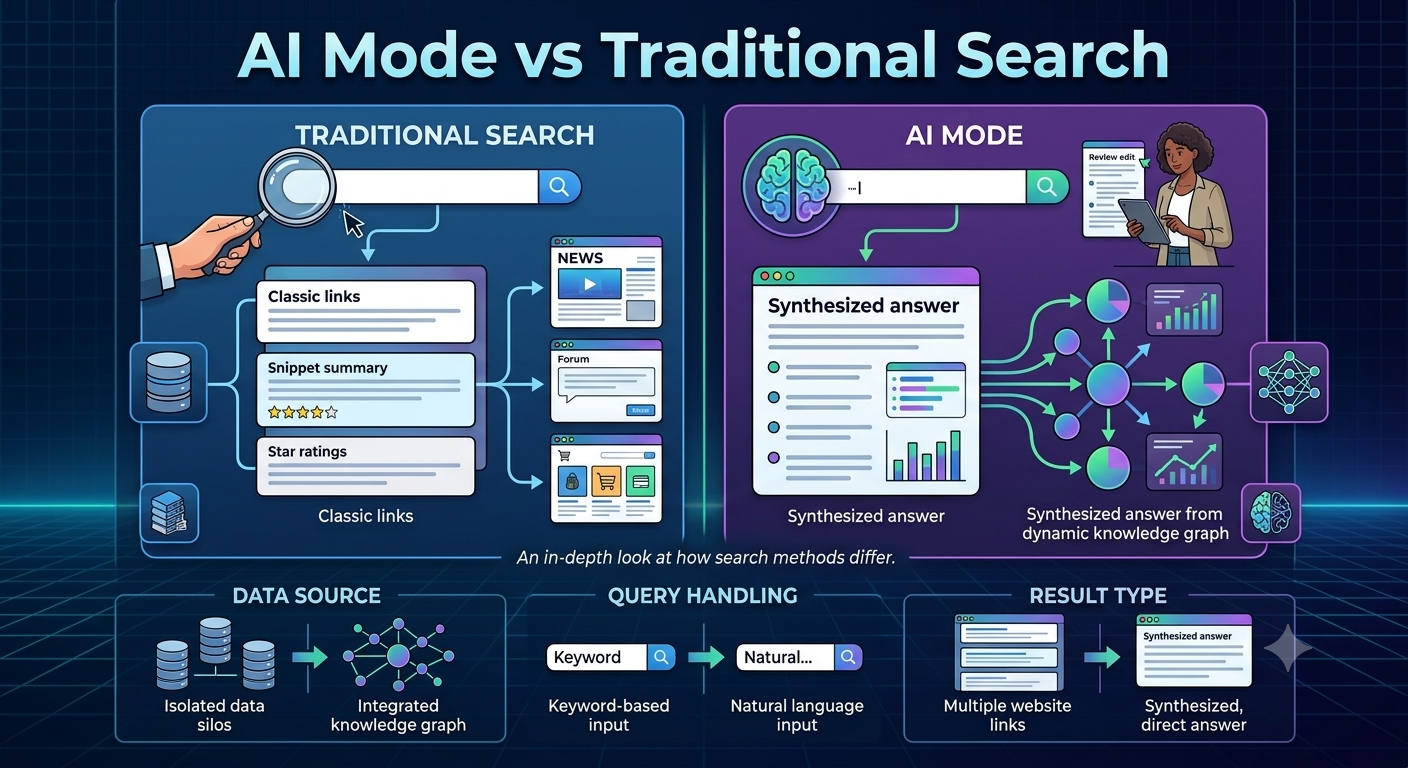
Although both systems help users find information, they work very differently. Here’s a side-by-side comparison.
| Feature | Traditional Google Search | Google AI Mode |
|---|---|---|
| Search Method | Keyword matching | Natural language understanding |
| Results | List of webpages | AI-generated summaries with supporting links |
| User Interaction | One search at a time | Conversational follow-up questions |
| Research Process | Multiple website visits | Information synthesized from several trusted sources |
| Complex Queries | Limited | Handles multi-step and detailed questions effectively |
| Personalization | Basic | Context-aware and more personalized |
| Speed | Depends on user research | Faster answers with summarized insights |
| Best For | Finding specific websites | Learning, researching, comparing, and problem-solving |
Both Google AI Mode and traditional Google Search have their own advantages, and the better choice depends on the type of search you’re doing.
Traditional Google Search is still ideal when you want to:
Google AI Mode is better when you want to:
Rather than replacing traditional search entirely, AI Mode complements it by delivering faster, more contextual answers while still directing users to trustworthy websites for deeper exploration.
Google AI Mode represents a significant evolution in online search. With features like conversational interactions, AI-generated summaries, multi-step reasoning, real-time information, and source citations, it offers a more intelligent way to find answers. For users, this means faster and more accurate search experiences. For businesses and publishers, it highlights the growing importance of creating trustworthy, well-structured, and valuable content that AI systems can confidently reference.
The rise of Google AI Mode is transforming the way websites receive organic traffic. For years, traditional SEO focused on ranking webpages as high as possible in Google’s search results. While rankings are still important, AI-powered search introduces a new layer of visibility—being referenced within AI-generated answers.
This means that success is no longer measured only by achieving the #1 position. Instead, websites must create content that Google’s AI considers accurate, trustworthy, and useful enough to summarize or cite.
In many cases, users may read an AI-generated answer before deciding whether to visit a website. As a result, publishers who consistently produce high-quality content have a better chance of maintaining visibility in an AI-first search experience.
Traditional SEO mainly focused on improving rankings for specific keywords. Google AI Mode, however, places greater emphasis on understanding the overall quality and usefulness of content.
Instead of relying solely on keyword optimization, Google’s AI evaluates whether your content:
This shift encourages publishers to prioritize user experience over search engine manipulation.
As AI-powered search grows, a new strategy called Generative Engine Optimization (GEO) has become increasingly important.
GEO is the process of creating content that is optimized not only for traditional search rankings but also for AI-generated search experiences.
The goal is to increase the likelihood that AI systems will reference, summarize, or recommend your content when answering user queries.
Unlike traditional SEO, GEO focuses on:
In many ways, GEO complements SEO rather than replacing it.
Avoid publishing articles that simply rewrite information from other websites.
Instead, add original value by including:
Unique content is more likely to stand out in AI-generated search results.
Google AI prefers content that provides direct answers before expanding into detailed explanations.
A good structure is:
This format improves readability for both users and AI systems.
A better approach is to publish several related articles that cover different aspects of the same topic. This helps both readers and search engines recognize your expertise.
For example, if your website focuses on AI, publish related content such as:
Interlinking these articles helps Google understand your expertise in the subject.
Google increasingly values content that reflects genuine knowledge and experience.
Include:
This helps establish credibility and trust.
AI systems prefer fresh information, especially for rapidly changing topics like artificial intelligence.
Review and update articles regularly to include:
Fresh content is more likely to remain relevant in AI-powered search.
Well-structured content is easier for both users and AI models to understand.
Best practices include:
Use simple, clear language that is easy for everyone to understand.
Connect related articles throughout your website.
Internal links help search engines understand relationships between topics while encouraging readers to explore additional content.
For example, an article about Google AI Mode could naturally link to:
Google looks for indicators that a website is reliable.
Strong trust signals include:
These elements contribute to long-term credibility.
Many websites struggle in AI-powered search because they continue using outdated SEO tactics.
Avoid these common mistakes:
Repeating the same keyword excessively makes content difficult to read and offers little value.
Instead, use natural language and related phrases.
Articles with only a few hundred words rarely provide enough depth for AI systems.
Comprehensive, well-researched guides generally perform better.
Copying or lightly rewriting information from other websites reduces originality.
Google rewards content that adds something new to the conversation.
Always consider what users actually want to know—not just the keywords they typed.
Content should solve problems, answer questions, and provide actionable information.
Large blocks of text discourage readers and make AI summarization more difficult.
Use headings, subheadings, lists, and concise paragraphs to improve readability.
Although AI Mode offers many advantages, it also has limitations.
Like all AI systems, Google AI Mode may occasionally generate incomplete or inaccurate information.
Users should verify important details using trusted sources.
Because AI provides direct answers, some users may no longer need to visit individual websites.
Publishers may see changes in click-through rates, even if their content contributes to AI-generated responses.
Low-quality, outdated, or misleading content is less likely to be referenced.
Websites must consistently publish reliable information to remain competitive.
AI search continues to evolve quickly.
SEO strategies that work today may require adjustments as Google introduces new features and ranking improvements.
Google AI Mode doesn’t signal the end of SEO—it marks the beginning of its next evolution.
Successful publishers will focus on creating content that is:
Instead of optimizing only for rankings, businesses will increasingly optimize for AI visibility.
Those who embrace both traditional SEO and Generative Engine Optimization (GEO) will be best positioned to succeed as AI-powered search becomes the standard.
Google AI Mode rewards websites that prioritize people over algorithms. By publishing original, authoritative, and well-structured content, businesses can improve their chances of being featured in AI-generated answers while continuing to build long-term organic visibility. As search evolves, combining strong SEO fundamentals with GEO best practices will be essential for sustained success.
Google AI Mode is more than just another search feature—it represents the future of how people interact with information online. As artificial intelligence continues to improve, search will become increasingly conversational, personalized, and capable of handling complex tasks that once required visiting multiple websites.
In the coming years, AI Mode is expected to evolve in several important ways:
Future versions of AI Mode will likely provide even more relevant answers by understanding user preferences, previous searches, location, and context—while respecting user privacy and giving people control over their data.
For example, if you frequently search for programming tutorials, AI Mode may prioritize technical resources and beginner-friendly explanations tailored to your interests.
AI Mode will become better at solving complex problems that involve multiple stages of reasoning.
Instead of answering a single question, it may help users:
This will make Google Search feel even more like an intelligent research assistant.
Google is expected to integrate AI Mode more deeply with products such as:
Users may eventually move seamlessly between search, productivity tools, navigation, and shopping with AI providing contextual assistance throughout the experience.
As AI models improve, Google will become more effective at identifying content that demonstrates genuine expertise and real-world experience.
Websites relying on low-quality, AI-generated, or duplicate content may find it increasingly difficult to gain visibility.
Publishers who consistently create original, accurate, and well-researched content will have a stronger chance of being referenced in AI-generated answers.
Traditional SEO will remain important, but Generative Engine Optimization (GEO) will become an essential strategy for businesses that want visibility in AI-powered search.
Future content strategies should focus on:
Businesses that adapt early will be better positioned as AI search continues to evolve.
AI Mode is Google’s AI-powered search experience that generates conversational answers by combining advanced language models with Google’s search index. Instead of showing only a list of webpages, it provides summarized responses supported by links to trusted sources.
Traditional Google Search primarily displays ranked webpages based on keywords and relevance. AI Mode understands user intent, analyzes information from multiple sources, generates summarized answers, and allows conversational follow-up questions.
Availability depends on Google’s rollout and regional support. Many AI-powered search features are available without additional cost, while some advanced capabilities may require participation in specific programs or subscriptions in certain regions.
No. AI Mode complements traditional search rather than replacing it. Users can still access standard search results and visit websites directly whenever they need detailed information.
Google evaluates content based on factors such as relevance, quality, authority, accuracy, and usefulness. AI-generated answers are supported by information from trusted webpages that meet Google’s quality standards.
For some informational searches, users may find answers directly within AI-generated responses, which could reduce clicks. However, websites that publish original, authoritative content can still gain visibility through citations and attract highly qualified visitors seeking more detailed information.
The best approach is to publish high-quality content that:
These practices improve the likelihood of being referenced in AI-generated answers.
Generative Engine Optimization (GEO) is the practice of optimizing content for AI-powered search engines. It combines traditional SEO with strategies that help AI systems understand, trust, and reference your content in generated responses.
AI-assisted content can perform well if it is accurate, original, helpful, and reviewed by knowledgeable humans. Simply publishing generic AI-generated text without adding value is unlikely to achieve strong long-term results.
AI-powered search is expected to play an increasingly important role, but traditional search results will continue to exist. The future will likely combine conversational AI, high-quality web content, and trusted sources to create a more efficient search experience.
Google AI Mode represents one of the most significant changes in the history of online search. By combining Google’s powerful search infrastructure with advanced generative AI, it delivers faster, more conversational, and context-aware answers while still connecting users to trustworthy sources across the web.
For users, AI Mode simplifies research, reduces the need to open multiple webpages, and makes complex topics easier to understand. Whether you’re comparing products, learning a new skill, or solving technical problems, AI-powered search provides a more efficient and interactive experience.
For businesses, bloggers, and digital marketers, AI Mode introduces a new era of search optimization. Success is no longer based solely on keyword rankings. Instead, creating original, authoritative, and user-focused content has become essential for earning visibility within AI-generated responses.
As AI search continues to evolve, the websites that invest in expertise, topical authority, clear content structure, and trustworthy information will be best positioned to succeed. Combining traditional SEO with Generative Engine Optimization (GEO) will help publishers remain competitive in an AI-first search landscape.
The future of search is not about replacing websites—it is about connecting users with the most reliable information more efficiently than ever before. By understanding how Google AI Mode works and adapting your content strategy today, you can prepare your website for the next generation of organic search.