Popular Posts

Google Gemini 3.5 Flash AI model interface in 2026

Google Gemini 3.5 Flash Explained (2026): Features, Benchmarks, Pricing & Comparison

Table of Contents

Google Gemini 3.5 Flash Explained (2026): Features, Benchmarks, Pricing & Comparison

Artificial Intelligence is evolving faster than ever, and Google’s latest model, Google Gemini 3.5 Flash, is one of the biggest AI launches of 2026. Announced during Google I/O 2026, Gemini 3.5 Flash is designed to deliver faster responses, smarter reasoning, advanced coding capabilities, and improved agentic AI performance — all while maintaining lower latency than large flagship models.

Unlike previous “Flash” models that mainly focused on speed and affordability, Gemini 3.5 Flash aims to compete directly with premium AI models like OpenAI GPT-5.5 and Anthropic Claude Opus 4.7 in coding, reasoning, and multi-step AI workflows. Many developers are calling it Google’s most balanced AI model yet.

In this article, we’ll explore Gemini 3.5 Flash features, benchmarks, pricing, comparisons, use cases, and whether it’s worth using in 2026.

What Is Google Gemini 3.5 Flash?

Gemini 3.5 Flash is Google DeepMind’s next-generation multimodal AI model built for fast and intelligent task execution. It supports text, images, audio, video, PDFs, coding, tool usage, and long-context understanding with up to a 1 million token context window.

Google designed the model specifically for:

  • AI agents
  • Coding workflows
  • Multi-step automation
  • Real-time productivity tasks
  • Long document analysis
  • Fast API responses
  • Search AI experiences

Gemini 3.5 Flash is now integrated across:

Gemini 3.5 Flash futuristic AI assistant illustration

What Are Agentic AI Features?

Agentic AI features refer to the abilities that allow an AI model to act more like an intelligent assistant that can plan, decide, and complete tasks autonomously instead of only answering questions.

Traditional AI chatbots mainly respond to prompts one step at a time. Agentic AI goes further by handling multi-step workflows, using tools, remembering goals, and making decisions during a task.

Companies like Google, OpenAI, and Anthropic are heavily investing in Agentic AI systems in 2026.

Main Agentic AI Features

1. Multi-Step Task Planning

Agentic AI can break a large task into smaller steps automatically.

Example:

Instead of only answering:

“How do I build a website?”

The AI can:

  1. Plan the website structure
  2. Generate code
  3. Create pages
  4. Fix errors
  5. Deploy the website

This makes AI more useful for real productivity work.

2. Tool Usage

Modern AI agents can use external tools like:

  • Web browsers
  • Code interpreters
  • APIs
  • File systems
  • Search engines
  • Calendars
  • Databases

Example:

An AI assistant could:

  • Search flight prices
  • Compare hotels
  • Create a travel plan
  • Add events to your calendar

all automatically.

3. Memory & Context Retention

Agentic AI remembers:

  • Previous instructions
  • Goals
  • Workflow progress
  • User preferences

This helps the AI continue long tasks without needing repeated instructions.

4. Autonomous Decision-Making

The AI can make logical decisions during tasks.

Example:

If one coding solution fails, the AI may:

  • Debug the error
  • Try another approach
  • Test outputs
  • Continue working automatically

without waiting for constant human prompts.

5. Reasoning & Problem Solving

Agentic AI models are designed for:

  • Complex reasoning
  • Strategic planning
  • Analysis
  • Workflow optimization

This is especially useful for:

  • Coding
  • Research
  • Automation
  • Business operations

6. Long-Horizon Task Execution

Agentic systems can work on tasks that take multiple stages or extended time.

Example:

A marketing AI agent could:

  • Research keywords
  • Write blog content
  • Generate images
  • Schedule posts
  • Analyze SEO performance

as one connected workflow.

7. Collaboration Between AI Agents

Some advanced systems use multiple specialized agents working together.

Example:

One AI agent handles:

  • Research

Another handles:

  • Writing

Another handles:

  • Coding or design

This creates a full AI workflow system.

Key Features of Gemini 3.5 Flash

1. Massive 1M Token Context Window

One of the biggest upgrades is the 1 million token context window. This allows Gemini 3.5 Flash to analyze extremely large PDFs, codebases, books, spreadsheets, and research documents in a single conversation.

That means users can:

  • Upload long business reports
  • Analyze huge code repositories
  • Summarize research papers
  • Process lengthy conversations
  • Handle enterprise-level documentation

2. Faster Response Speed

Google claims Gemini 3.5 Flash delivers output speeds exceeding 280 tokens per second, making it one of the fastest frontier AI models available in 2026.

This speed improvement makes the model ideal for:

  • Real-time coding
  • AI chatbots
  • Search engines
  • Automation tools
  • Live productivity assistants

3. Advanced Coding Performance

Gemini 3.5 Flash was heavily optimized for coding and software engineering tasks.

It performs strongly in:

  • Python
  • JavaScript
  • React
  • Tailwind CSS
  • App generation
  • Debugging
  • Tool calling
  • Multi-agent workflows

The model reportedly beats Gemini 3.1 Pro on several coding benchmarks.

4. Agentic AI Capabilities

Google is focusing heavily on “AI agents” in 2026, and Gemini 3.5 Flash is built specifically for long-horizon tasks.

This means the AI can:

  • Plan multiple steps
  • Use external tools
  • Perform autonomous workflows
  • Handle complex instructions
  • Coordinate sub-agents

5. Multimodal Understanding

Gemini 3.5 Flash supports:

  • Text input
  • Image understanding
  • Audio processing
  • Video analysis
  • PDF reading
  • Chart interpretation

Its multimodal benchmark performance is among the strongest in Google’s lineup.

Gemini 3.5 Flash Benchmarks (2026)

Google officially launched Gemini 3.5 Flash at Google I/O 2026 as its fastest and strongest “Flash” AI model focused on coding, AI agents, and long-horizon reasoning tasks. According to Google, the model outperforms older Gemini Pro models on several important benchmarks while running significantly faster.

Here are some major benchmark results reported for Gemini 3.5 Flash:

Benchmark Gemini 3.5 Flash Score
Terminal-Bench 2.1 76.2%
SWE-Bench Pro 55.1%
MCP Atlas 83.6%
MMMU-Pro 83.6%
CharXiv 84.2%
Humanity’s Last Exam 40.2%
ARC-AGI-2 72.1%

These scores show major improvements in:

  • Agentic reasoning
  • Coding performance
  • Tool use
  • Multimodal intelligence
  • Workflow execution

However, some reasoning-focused benchmarks still favor Gemini 3.1 Pro or GPT-5.5 for extremely difficult academic tasks.

Google claims Gemini 3.5 Flash beats Gemini 3.1 Pro on coding and agentic benchmarks. The model is designed for:

  • code generation
  • debugging
  • terminal automation
  • multi-step developer workflows

The biggest coding benchmark improvement came in:

Terminal-Bench 2.1 → 76.2%

This benchmark measures how well an AI model performs real terminal and developer tasks.

Multimodal Capabilities

Gemini 3.5 Flash supports multiple input formats including:

  • Text
  • Images
  • Documents
  • Charts
  • Audio
  • Voice interactions

This makes it useful for applications like:

  • AI search
  • Visual understanding
  • Document summarization
  • AI assistants
  • Image reasoning
  • Interactive workflows

Google also integrated Gemini Live features into the Gemini app for more natural voice interactions.

Agentic AI Benchmarks

One of the biggest reasons Gemini 3.5 Flash is trending is its strong “agentic AI” performance.

Google focused heavily on:

  • autonomous workflows
  • tool calling
  • multi-step task execution
  • AI agents

MCP Atlas Score → 83.6%

This benchmark measures how reliably an AI agent can use tools across long workflows. Some AI community discussions suggest this benchmark is more important than SWE-Bench for real AI agents.

Gemini 3.5 Flash Speed

Google says Gemini 3.5 Flash is:

  • around 4× faster than competing frontier models
  • optimized for low latency
  • capable of generating nearly 280+ tokens per second in some tests

This makes it useful for:

  • live coding
  • AI assistants
  • real-time automation
  • productivity apps

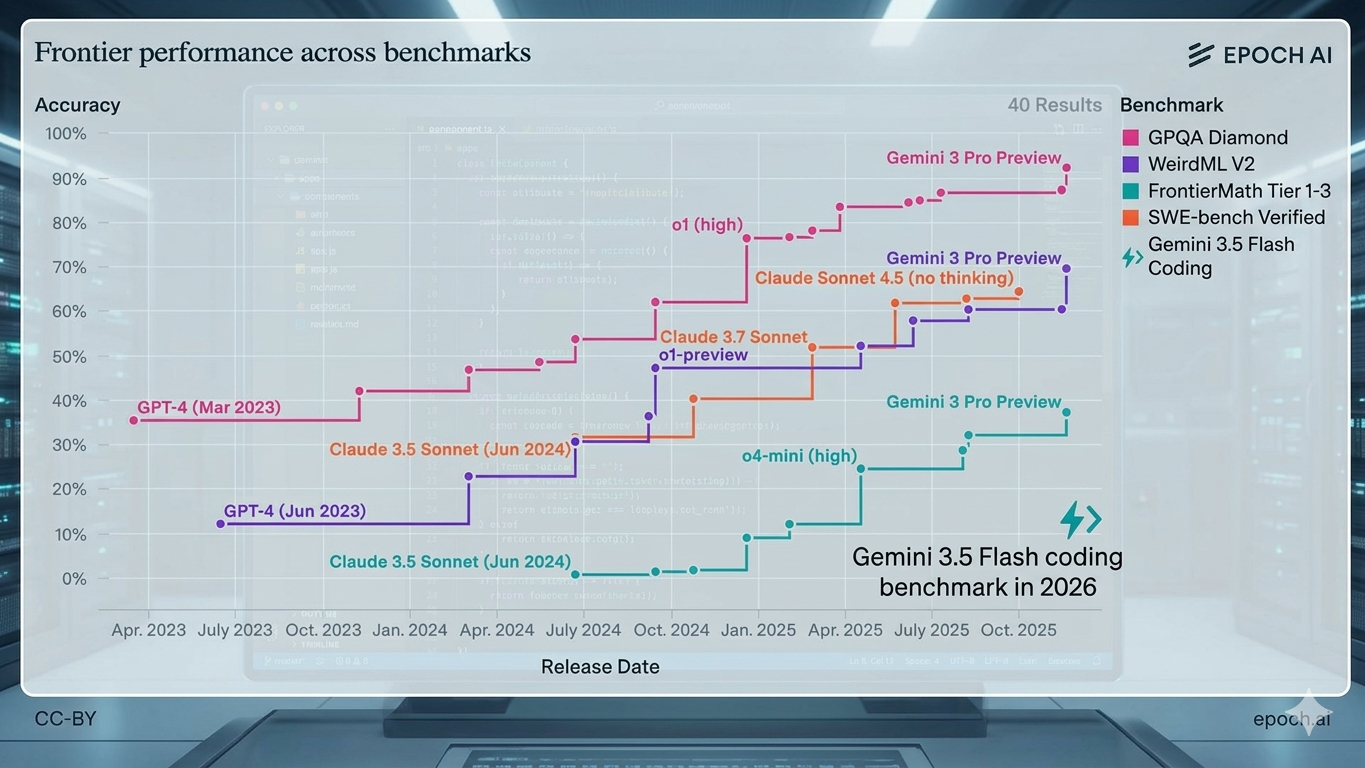
Gemini 3.5 Flash coding benchmark in 2026

Gemini 3.5 Flash Coding Performance?

Google Gemini 3.5 Flash shows major improvements in coding performance compared to previous Gemini models. Google optimized the AI for software engineering tasks such as code generation, debugging, automation, and full-stack app development.

The model performs strongly in:

  • Python programming
  • JavaScript development
  • React and Tailwind CSS
  • API integration
  • Error fixing
  • Code explanation
  • Multi-file project understanding

One of the biggest advantages of Gemini 3.5 Flash is its fast response speed combined with a massive context window. Developers can upload large codebases and ask the AI to analyze, improve, or debug projects efficiently.

Gemini 3.5 Flash also supports agentic coding workflows, allowing the AI to complete multi-step programming tasks with minimal human input. This makes it useful for startups, developers, and businesses looking to automate software development processes in 2026.

According to benchmark tests like SWE-Bench and Terminal-Bench, Gemini 3.5 Flash competes closely with top AI coding models such as OpenAI GPT-5.5 and Anthropic Claude Opus.

One of the biggest highlights of Google Gemini 3.5 Flash is its impressive coding performance. The model is designed to handle complex programming tasks including code generation, debugging, app development, and multi-step coding workflows. It supports popular programming languages like Python, JavaScript, React, TypeScript, and more. Compared to older Gemini models, Gemini 3.5 Flash delivers faster responses, better code accuracy, and improved reasoning for software development tasks. This makes it a strong AI tool for developers, students, and businesses in 2026.

Gemini 3.5 Flash Pricing (2026)

Google launched Gemini 3.5 Flash as its fast and cost-efficient AI model for developers, coding, automation, and AI agents. The model became widely available after Google I/O 2026 and is now one of Google’s main AI API offerings.

Gemini 3.5 Flash API Pricing

Usage Type Price
Input Tokens $1.50 per 1 million tokens
Output Tokens $9.00 per 1 million tokens
Cached Input Tokens Around $0.15 per 1 million tokens
Batch API Discount Up to 50% discount

What Do These Prices Mean?

  • Input tokens = your prompt or uploaded content
  • Output tokens = AI-generated response
  • Cached tokens = repeated prompts stored for cheaper reuse
  • Batch processing = lower-cost background requests

Example Cost Calculation

If you send:

  • 500,000 input tokens
  • 200,000 output tokens

Estimated cost:

  • Input: $0.75
  • Output: $1.80

Total ≈ $2.55

Free Tier Availability

Google AI Studio still offers a free developer tier for testing Gemini models.

Free usage may include:

  • Limited daily requests
  • RPM (requests per minute) limits
  • Smaller production quotas

Why Gemini 3.5 Flash Costs More Than Older Flash Models

Many developers noticed the pricing increase compared to older Gemini Flash versions.

Community discussions on Reddit mention that:

  • Gemini 3.5 Flash is focused more on agentic AI
  • Better coding performance
  • Faster reasoning
  • Longer context handling
  • Improved multimodal support

Because of these upgrades, pricing is higher than Gemini 2.5 Flash or Gemini 3 Flash Preview.

Gemini 3.5 Flash vs Previous Gemini Pricing

Model Input Price Output Price
Gemini 2.5 Flash ~$0.30 ~$2.50
Gemini 3 Flash Preview ~$0.50 ~$3.00
Gemini 3.5 Flash $1.50 $9.00

Key Features Included in Pricing

Gemini 3.5 Flash supports:

  • 1M token context window
  • Multimodal inputs (text, image, audio, video)
  • Tool calling
  • AI agents
  • Structured JSON output
  • Prompt caching
  • High-speed inference

Final Thoughts

Google DeepMind positioned Gemini 3.5 Flash between budget AI models and premium frontier models. While it is more expensive than older Flash models, it offers stronger reasoning, better coding performance, faster responses, and advanced AI agent capabilities.

Gemini 3.5 Flash vs Gemini 3.1 Pro (2026)

Google’s AI lineup changed a lot in 2026. Gemini 3.5 Flash focuses on speed, coding, and AI agents, while Gemini 3.1 Pro is built more for deep reasoning, research, and complex tasks.

Quick Comparison Table

Feature Gemini 3.5 Flash Gemini 3.1 Pro
Main Focus Speed + AI Agents Deep Reasoning
Performance Faster responses Smarter reasoning
Coding Ability Excellent Very strong
Agentic Tasks Better Good
Long Context Accuracy Good Better
Multimodal Support Yes Yes
Speed Very fast Slower
API Pricing Cheaper More expensive
Best For Automation, coding agents, best AI chatbot in 2026 Research, analysis, advanced reasoning

What Is Gemini 3.5 Flash?

Google designed Gemini 3.5 Flash as a fast and efficient AI model for:

  • AI agents
  • Coding assistants
  • Workflow automation
  • Multi-step tasks
  • Real-time apps

Google claims it outperforms Gemini 3.1 Pro on several coding and agent benchmarks while running much faster.

Key Strengths

  • Faster output generation
  • Better tool calling
  • Lower latency
  • Strong coding performance
  • Optimized for AI automation

Best Use Cases

  • AI SaaS tools
  • Chatbots
  • Coding copilots
  • Browser agents
  • Automation workflows

What Is Gemini 3.1 Pro?

Gemini 3.1 Pro is Google’s advanced reasoning-focused model.

It is designed for:

  • Research tasks
  • Deep logical thinking
  • Scientific reasoning
  • Long-document understanding
  • Advanced problem solving

Google improved “Deep Think” reasoning in this version, making it stronger for complex workflows and analysis.

Key Strengths

  • Better logical reasoning
  • Stronger long-context understanding
  • Higher accuracy on difficult tasks
  • Better visual reasoning

Best Use Cases

  • Research papers
  • Data analysis
  • Advanced coding logic
  • Enterprise AI systems
  • Long document summarization

Coding Performance Comparison

Gemini 3.5 Flash became popular mainly because of its coding and agent performance.

According to multiple benchmark reports:

  • Gemini 3.5 Flash scored higher in:
    • Terminal-Bench
    • MCP Atlas
    • Finance Agent benchmarks
    • Tool-use evaluations

However, Gemini 3.1 Pro still performs better in:

  • Deep reasoning
  • Complex logic
  • Hard problem-solving benchmarks
  • Visual reasoning tasks

Speed Difference

One of the biggest differences is speed.

Gemini 3.5 Flash

  • Extremely fast
  • Lower latency
  • Better for real-time apps
  • Designed for high-volume AI systems

Gemini 3.1 Pro

  • Slower but more thoughtful
  • Better for careful analysis
  • Uses deeper reasoning steps

Google intentionally made Gemini 3.1 Pro slower in some tasks to improve reasoning quality.

Pricing Comparison

Model Input Price Output Price
Gemini 3.5 Flash ~$1.50 / 1M ~$9 / 1M
Gemini 3.1 Pro Higher pricing Higher pricing

Gemini 3.5 Flash is cheaper than Gemini 3.1 Pro for most workloads.

Community Opinions

Developer opinions are mixed.

Some Reddit users say:

  • Gemini 3.5 Flash is excellent for speed and agents
  • Gemini 3.1 Pro still feels smarter for difficult reasoning
  • Flash is better for automation
  • Pro is better for high-accuracy thinking

Which One Should You Choose?

Choose Gemini 3.5 Flash If You Want:

  • Fast AI responses
  • Coding agents
  • AI automation
  • Lower API cost
  • Real-time applications

Choose Gemini 3.1 Pro If You Want:

  • Better reasoning
  • Research-level analysis
  • More accurate complex outputs
  • Long-context understanding
  • Enterprise-grade thinking

Final Thoughts

Gemini 3.5 Flash and Gemini 3.1 Pro target different users.

  • Gemini 3.5 Flash is built for speed, coding, and AI agents.
  • Gemini 3.1 Pro is built for deep reasoning and advanced intelligence.

For most developers and startups, Gemini 3.5 Flash offers a better balance of speed and cost. But for complex research and high-level reasoning, Gemini 3.1 Pro still remains one of Google’s smartest AI models.

Google Gemini 3.5 Flash pricing and API cost infographic

Gemini 3.5 Flash vs GPT-5.5

OpenAI GPT-5.5 remains one of the strongest reasoning-focused AI models in 2026, while Gemini 3.5 Flash focuses more on speed and scalable agentic workflows.

Category Gemini 3.5 Flash GPT-5.5
Speed Faster Slower
Coding Speed Excellent Excellent
Reasoning Strong Stronger
Tool Usage Excellent Excellent
Frontend Generation Very Strong Strong
Cost Efficiency Mixed Premium
Multimodal Features Advanced Advanced

Many developers currently use:

  • Gemini 3.5 Flash for fast execution
  • GPT-5.5 for deeper reasoning tasks

Gemini 3.5 Flash and GPT-5.5 are two of the most advanced AI models in 2026, but they focus on different strengths. Gemini 3.5 Flash is optimized for speed, AI agents, multitasking, and lower API costs, making it ideal for automation tools, coding copilots, and real-time applications. On the other hand, GPT-5.5 focuses more on deep reasoning, advanced coding accuracy, and complex problem-solving. Benchmark comparisons show GPT-5.5 leading in difficult coding tasks like SWE-bench Pro, while Gemini 3.5 Flash performs extremely well in agentic workflows and tool-calling benchmarks. GPT-5.5 also offers a slightly larger context window, but Gemini 3.5 Flash is significantly cheaper for developers running large-scale apps. Many developers describe Gemini 3.5 Flash as “faster and more efficient,” while GPT-5.5 is often considered “smarter and more reliable” for difficult reasoning tasks.

Real User Opinions in 2026

Real-world users in 2026 have mixed opinions about Gemini 3.5 Flash and GPT-5.5. Many developers praise Gemini 3.5 Flash for its incredible speed, lower API pricing, and strong AI-agent performance. Users especially like it for frontend coding, automation, and tool-calling workflows. Some reviewers even reported that Gemini 3.5 Flash solved coding bugs faster than GPT-5.5 in certain real-world tests.

However, a large number of Reddit users still believe GPT-5.5 feels smarter and more reliable for deep reasoning, difficult coding tasks, and long problem-solving sessions. Several developers mentioned that GPT-5.5 produces cleaner code, fewer hallucinations, and more accurate outputs in complex workflows.

Community feedback also shows that pricing became a major discussion in 2026. Many indie developers prefer Gemini 3.5 Flash because it is around 3x cheaper than GPT-5.5 while still offering competitive benchmark performance. Users building SaaS tools and AI automation platforms often say Gemini gives better value for money.

At the same time, advanced users and enterprise developers often continue choosing GPT-5.5 because of its stronger reasoning abilities and better consistency on difficult tasks. Benchmark comparisons show GPT-5.5 still leading in SWE-bench Pro and high-level coding evaluations.

Overall, real user opinions in 2026 suggest:

  • Gemini 3.5 Flash → Best for speed, AI agents, automation, and affordability
  • GPT-5.5 → Best for deep reasoning, advanced coding, and reliability

Most users agree that both models are extremely powerful, and the final choice depends more on workflow, budget, and use case rather than one model being universally better.

Community discussions across Reddit and developer forums show mixed but mostly positive reactions.

What Users Like

  • Extremely fast generation
  • Strong frontend coding
  • Better AI agents
  • Excellent multimodal support
  • Smooth real-time experience

Common Complaints

  • Higher API pricing
  • Increased token usage
  • Sometimes weaker deep reasoning than Pro models
  • Expensive for large-scale deployments

Some developers believe Gemini 3.5 Flash is currently one of the best AI models for rapid frontend development and agentic coding workflows.

Best Use Cases of Gemini 3.5 Flash

Gemini 3.5 Flash is designed for users who need fast AI performance, strong coding abilities, and advanced AI-agent workflows. Google mainly optimized this model for automation, multitasking, and real-time applications rather than slow deep reasoning tasks.

Gemini 3.5 Flash works best for:

AI Coding Assistants

Fast code generation and debugging.

AI Agents

Handling tool calls and long workflows.

Customer Support Bots

Real-time AI conversations with low latency.

Content Creation

Quick article writing and summarization.

Search & Productivity

Integrated AI search experiences.

Frontend Development

React, Tailwind, and UI generation tasks.

Is Gemini 3.5 Flash Worth Using in 2026?

Yes, Gemini 3.5 Flash is worth using in 2026 for many developers, creators, and businesses—especially if you need fast AI performance at a lower cost. The model delivers strong coding abilities, excellent AI-agent support, multimodal features, and very fast response times, making it ideal for chatbots, automation tools, SaaS products, and real-time applications. Many developers also prefer it because it is cheaper than premium frontier models while still offering competitive benchmark performance.

Gemini 3.5 Flash is best for:

  • AI coding tools
  • Chatbots
  • AI automation
  • SaaS apps
  • Long-context document analysis
  • Agentic workflows

For small projects, the free tier is usually enough.
For production apps, developers may need caching and batch APIs to reduce costs.

However, whether it is “worth it” depends on your use case. If your work involves deep reasoning, advanced research, or highly complex problem-solving, models like GPT-5.5 or Gemini 3.1 Pro may still provide more accurate and reliable results. But for most everyday AI tasks—including coding, automation, customer support, content workflows, and frontend development—Gemini 3.5 Flash offers one of the best balances of speed, features, and pricing in 2026.

Leave a Reply

Your email address will not be published. Required fields are marked *