 11
11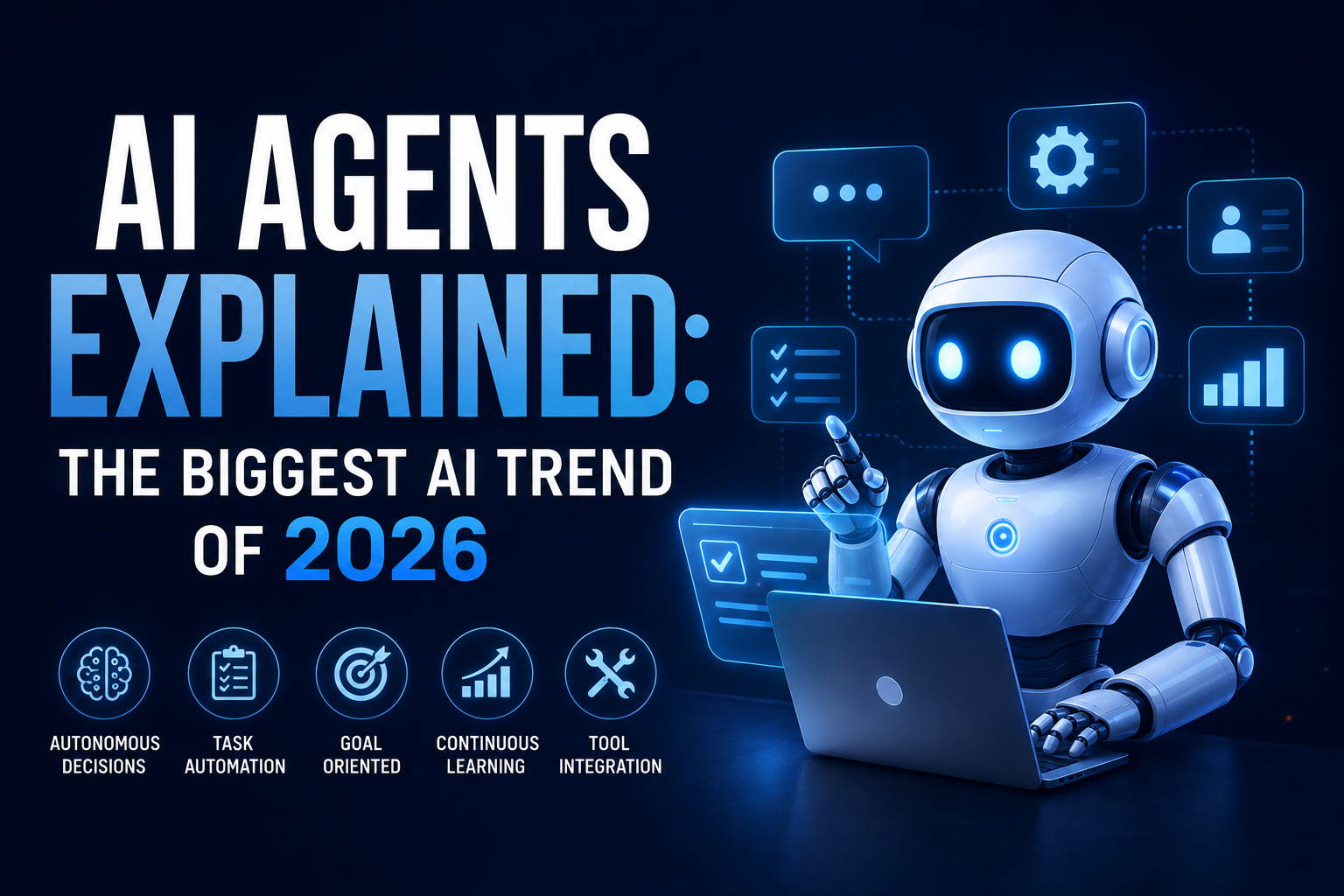
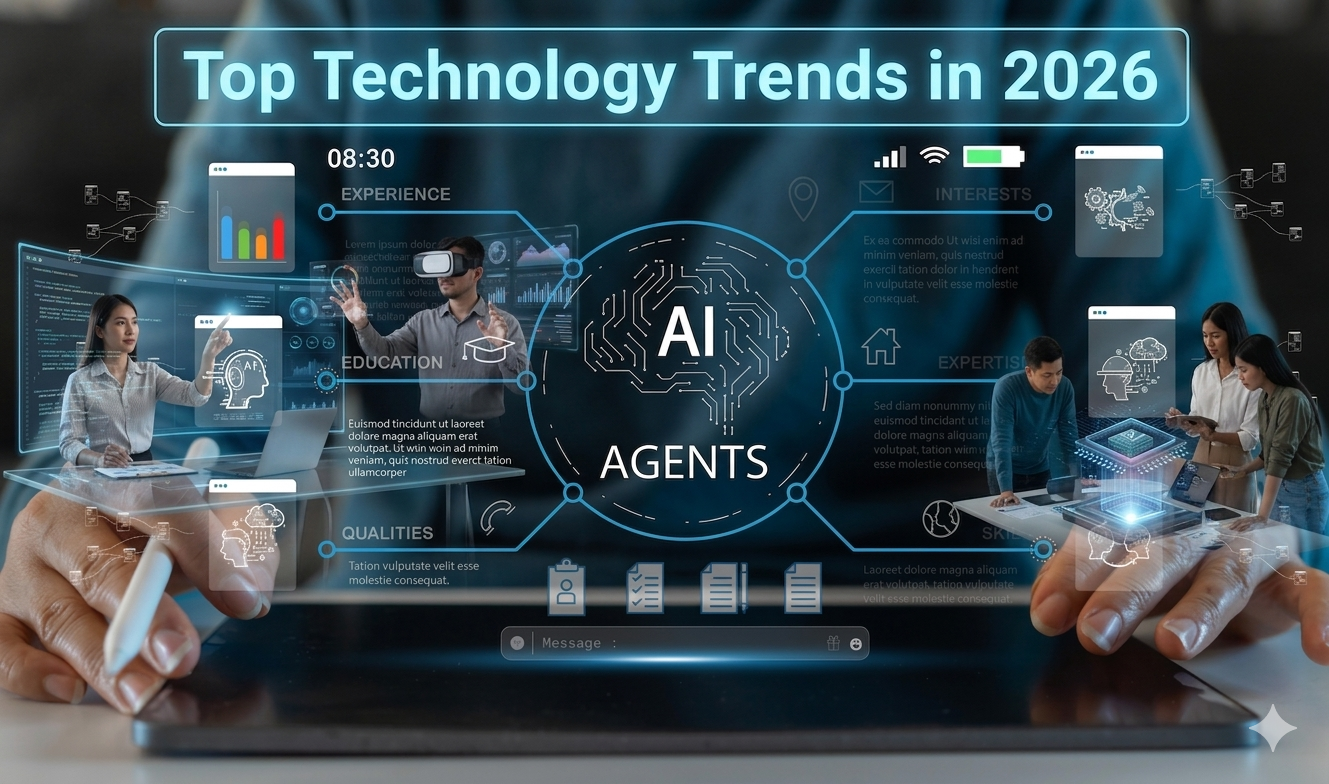
Artificial intelligence is evolving faster than ever, and one term dominating the tech industry in 2026 is AI Agents. While traditional AI chatbots can answer questions and generate content, AI agents take things much further. They can plan tasks, make decisions, use external tools, and complete complex workflows with minimal human involvement.
From businesses automating customer support to developers building autonomous AI systems, AI agents are becoming a major focus across industries. Many experts believe that AI agents could transform the way people work, similar to how smartphones changed communication.
In this guide, we’ll explain what AI agents are, how they work, their benefits, real-world applications, and why they are considered the biggest AI trend of 2026.
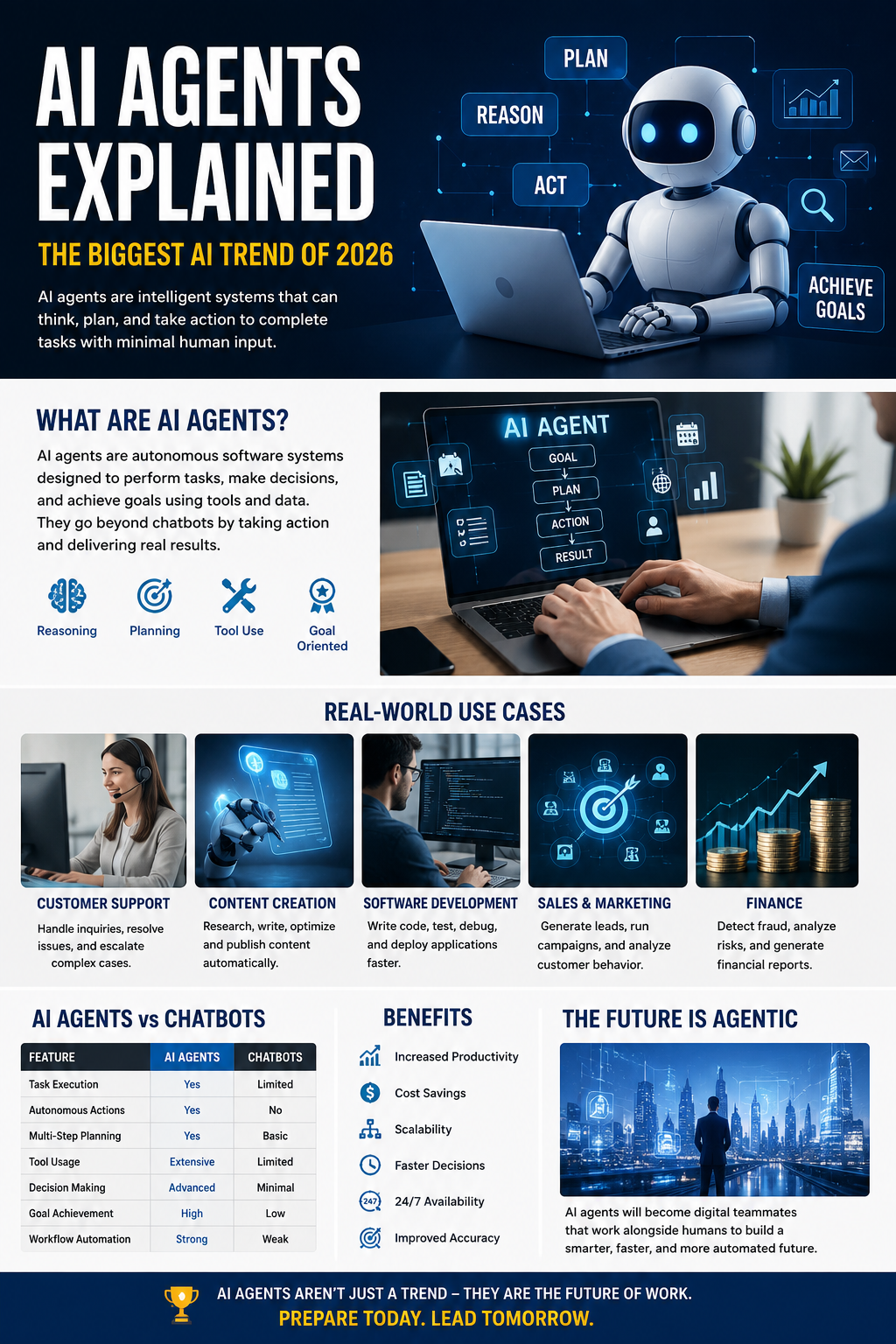
AI agents are intelligent software systems that can understand goals, make decisions, perform tasks, and take actions with minimal human intervention. Unlike traditional AI tools that only respond to prompts, AI agents can plan, reason, execute tasks, and adapt based on results. Models such as Google Gemini 3.5 Flash are helping power next-generation AI agent systems.
In simple terms, an AI agent acts like a digital assistant that not only answers questions but can also complete multi-step tasks on your behalf.
Unlike traditional AI models that simply respond to prompts, AI agents can:
Think of an AI chatbot as an assistant that answers questions. An AI agent acts more like a digital employee capable of handling complete tasks from start to finish.
Instead of asking:
“Write an email about a product launch.”
You could tell an AI agent:
“Plan and execute a product launch campaign.”
The AI agent may:
All with minimal human intervention.
AI agents have become one of the biggest technology latest AI trends of 2026 because they represent the next evolution of artificial intelligence. Unlike traditional AI tools that require constant user instructions, AI agents can understand goals, break them into smaller tasks, and execute those tasks independently. This shift from simple question-answering systems to autonomous digital assistants is transforming how businesses and individuals work.
Several factors are driving this rapid growth. First, advances in large language models have significantly improved reasoning, planning, and decision-making capabilities. Second, AI agents can now connect with external tools such as web browsers, databases, email platforms, calendars, and business software, allowing them to perform real-world tasks instead of only generating text. Third, companies are under pressure to increase productivity while reducing operational costs, making AI-powered automation an attractive solution.
Several factors are driving the rapid growth of AI agents in 2026.
Modern AI systems are becoming better at reasoning, planning, and understanding complex instructions.
Businesses are looking for ways to reduce repetitive work and improve productivity.
AI agents can complete workflows rather than single actions.
AI agents can connect with:
Companies can automate routine tasks and improve efficiency without significantly increasing staffing costs.
Businesses across industries are using AI agents for customer service, content creation, market research, software development, sales outreach, data analysis, and workflow automation. For example, an AI agent can research competitors, create reports, schedule meetings, respond to emails, and update CRM systems with little human intervention. This level of automation helps organizations save time, improve efficiency, and focus employees on higher-value work.
The rise of agentic AI platforms from leading companies such as OpenAI, Google DeepMind, Microsoft, and Anthropic has also accelerated adoption. These platforms make it easier for businesses to build and deploy AI agents without requiring advanced technical expertise. As a result, startups, enterprises, and individual creators are increasingly integrating AI agents into their daily operations.
Another reason AI agents are gaining attention is their potential to act as digital coworkers. Rather than assisting with a single task, they can manage entire workflows from start to finish. Many experts believe AI agents will become as essential to knowledge work as email, cloud computing, and smartphones were in previous decades.
As AI technology continues to improve, AI agents are expected to become more intelligent, personalized, and capable of handling complex responsibilities. This combination of automation, efficiency, and real-world task execution is why AI agents are trending so strongly in 2026 and are widely considered the future of AI-powered productivity.
AI agents work by combining artificial intelligence, reasoning capabilities, memory, and external tools to complete tasks autonomously. Instead of responding to a single prompt like a traditional chatbot, an AI agent follows a multi-step process to achieve a specific goal.
First, the agent receives a task or objective from the user, such as researching a topic, writing a report, analyzing data, or scheduling meetings. It then breaks the goal into smaller steps and creates a plan to complete each part efficiently. Using advanced language models, the agent can understand context, reason through problems, and determine the best actions to take.
Next, the AI agent interacts with various tools and data sources. Depending on its capabilities, it may search the web, access databases, use software applications, generate content, write code, or communicate with other systems through APIs. As it gathers information, the agent continuously evaluates results and adjusts its actions to stay aligned with the original objective.
A key feature of modern AI agents is memory. They can remember previous interactions, store important information, and use that knowledge to make better decisions over time. This allows agents to provide more personalized and accurate assistance compared to traditional AI systems.
The basic workflow of an AI agent can be summarized as:
Goal → Planning → Action → Observation → Decision → Completion
For example, if a user asks an AI agent to create a market research report, the agent can automatically search for industry trends, collect relevant data, analyze findings, generate a structured report, and present the final document. Throughout the process, it monitors progress and makes decisions without requiring constant human guidance.
This ability to plan, act, learn, and adapt is what makes AI agents more powerful than standard chatbots. As AI technology advances in 2026, agents are becoming increasingly capable of handling complex workflows, making them valuable tools for businesses, developers, marketers, and everyday users.
Most AI agents follow a simple cycle:
The user provides an objective, such as “Research competitors and create a summary report.”
The user provides an objective.
Example: Generate monthly sales reports.
The AI agent breaks the task into smaller steps.
The agent breaks the objective into smaller steps, for example:
Search for competitors.
Collect key information.
Analyze strengths and weaknesses.
Generate a report.
The AI model analyzes the task, identifies the intent, and determines what information or actions are required.
AI agents can interact with external systems, such as:
Web browsers
Search engines
Databases
Email and calendar apps
Code interpreters
Business software (CRM, spreadsheets, project management tools)
After each action, the agent evaluates the results and decides what to do next. This iterative reasoning allows it to adapt if new information appears.
Once the task is complete, the agent delivers the result—such as a report, email draft, code solution, or scheduled meeting.
AI agents are different from traditional AI chatbots because they can think through tasks, make decisions, and take actions to achieve specific goals. Here are the most important features that make AI agents powerful in 2026:
AI agents can work independently without requiring constant human instructions. They analyze objectives, choose the best course of action, and execute tasks while adapting to changing conditions.
Instead of simply responding to prompts, AI agents focus on achieving outcomes. Users provide a goal, and the agent determines the steps needed to complete it efficiently.
AI agents can break complex projects into smaller tasks, prioritize them, and execute them in the correct order. This allows them to handle multi-step workflows that would normally require human coordination.
Modern AI agents can remember previous interactions, ongoing tasks, and relevant information. This enables more personalized responses and helps maintain continuity across long projects.
AI agents can connect with external tools and software, including web browsers, databases, email platforms, calendars, CRMs, spreadsheets, and cloud services. This allows them to perform real-world actions rather than just generate text.
Advanced AI agents use reasoning capabilities to analyze information, compare options, identify patterns, and make informed decisions. This makes them useful for research, coding, business analysis, and strategic planning.
Many AI agents can access live data from the internet and connected systems. This helps them provide up-to-date information, monitor trends, and respond to changing circumstances.
Some platforms allow multiple AI agents to work together on a project. One agent may conduct research, another may analyze data, and a third may generate reports, creating a highly efficient workflow.
AI agents can improve their performance by learning from feedback, user preferences, and previous interactions. This enables them to become more effective over time.
Users can interact with AI agents using everyday language. There is no need for complex commands or programming knowledge, making the technology accessible to a wider audience.
AI agents can automate repetitive tasks such as data entry, scheduling, customer support, report generation, content creation, and email management. This helps businesses save time and reduce operational costs.
Unlike human workers, AI agents can handle multiple tasks simultaneously and operate 24/7. Organizations can deploy them across departments to increase productivity without significantly increasing costs.
Although both AI agents and traditional AI chatbots use artificial intelligence to interact with users, their capabilities are very different. Traditional chatbots are designed primarily to answer questions and provide information, while AI agents can take actions, make decisions, and complete complex tasks autonomously.
| Feature | Traditional AI Chatbots | AI Agents |
|---|---|---|
| Primary Purpose | Answer questions and generate responses | Achieve goals and complete tasks |
| Decision-Making | Limited | Advanced reasoning and planning |
| Task Execution | Mostly text-based responses | Can perform real-world actions |
| Tool Integration | Minimal or none | Connects to apps, APIs, and software |
| Memory | Short-term conversation context | Long-term memory and task tracking |
| Autonomy | Requires continuous user prompts | Can work independently |
| Workflow Management | Handles one request at a time | Manages multi-step workflows |
| Problem Solving | Basic | Advanced analysis and decision-making |
| Business Applications | Customer support and FAQs | Research, automation, coding, operations, and more |
In short, AI agents are designed to act, not just respond.
Traditional AI chatbots are designed to respond to user queries in a conversational format. They excel at answering questions, generating text, translating languages, and providing customer support. However, they generally require users to guide every step of the interaction. Once a response is delivered, the chatbot usually waits for the next instruction.
For example, if you ask a traditional chatbot to create a market research report, it may provide guidance or generate content, but you typically need to perform the research and data collection yourself.
AI agents go beyond conversation. They can understand objectives, create plans, gather information, use external tools, and execute tasks with minimal human involvement. Instead of simply responding, they actively work toward completing a goal.
For example, if you ask an AI agent to create a market research report, it can search for information, analyze competitors, organize findings, and generate a complete report automatically.
AI agents are already being used across industries to automate tasks, improve efficiency, and reduce operational costs. Unlike traditional AI chatbots, AI agents can perform actions, manage workflows, and complete multi-step processes with minimal human intervention. Here are some of the most common real-world AI agent use cases in 2026.
Businesses use AI agents to handle customer inquiries, resolve common issues, process refunds, track orders, and provide 24/7 support. These agents can access company databases and CRM systems to deliver personalized assistance while reducing the workload on human support teams.
Marketing teams use AI agents to research topics, generate blog posts, create social media content, optimize SEO, and analyze campaign performance. AI agents can automate large portions of the content creation process, helping businesses publish high-quality content faster.
Developers use AI agents to write code, debug applications, review pull requests, generate documentation, and test software. These agents can significantly accelerate development cycles and improve productivity by handling repetitive coding tasks.
AI agents can identify potential customers, gather contact information, personalize outreach emails, schedule meetings, and update CRM records automatically. This allows sales teams to focus more on closing deals and building relationships.
Companies use AI agents to monitor industry trends, track competitors, analyze customer sentiment, and generate detailed research reports. Tasks that previously took days can now be completed in hours or even minutes.
Individuals use AI agents as digital assistants to manage calendars, schedule appointments, organize tasks, draft emails, create reminders, and summarize important documents. These agents help users stay organized and save valuable time.
Financial teams use AI agents to analyze data, generate forecasts, track expenses, prepare reports, and identify business opportunities. AI-powered automation helps organizations make faster and more informed decisions.
AI agents assist HR departments by screening resumes, scheduling interviews, answering candidate questions, onboarding new employees, and managing routine administrative tasks. This improves hiring efficiency and enhances the candidate experience.
Healthcare organizations use AI agents to manage appointment scheduling, patient communication, medical record organization, insurance verification, and administrative workflows. By reducing paperwork and repetitive tasks, healthcare professionals can spend more time focusing on patient care.
Online stores deploy AI agents to recommend products, manage inventory, monitor pricing, process customer inquiries, and automate order tracking. These capabilities improve customer satisfaction while increasing operational efficiency.
Security teams use AI agents to monitor networks, detect suspicious activity, investigate threats, and generate incident reports. AI agents can analyze large volumes of security data much faster than manual processes.
AI agents help teams plan projects, assign tasks, track deadlines, generate status reports, and identify potential risks. This improves collaboration and ensures projects stay on schedule. Businesses also use the best AI video generator tools to create marketing content alongside AI agents.
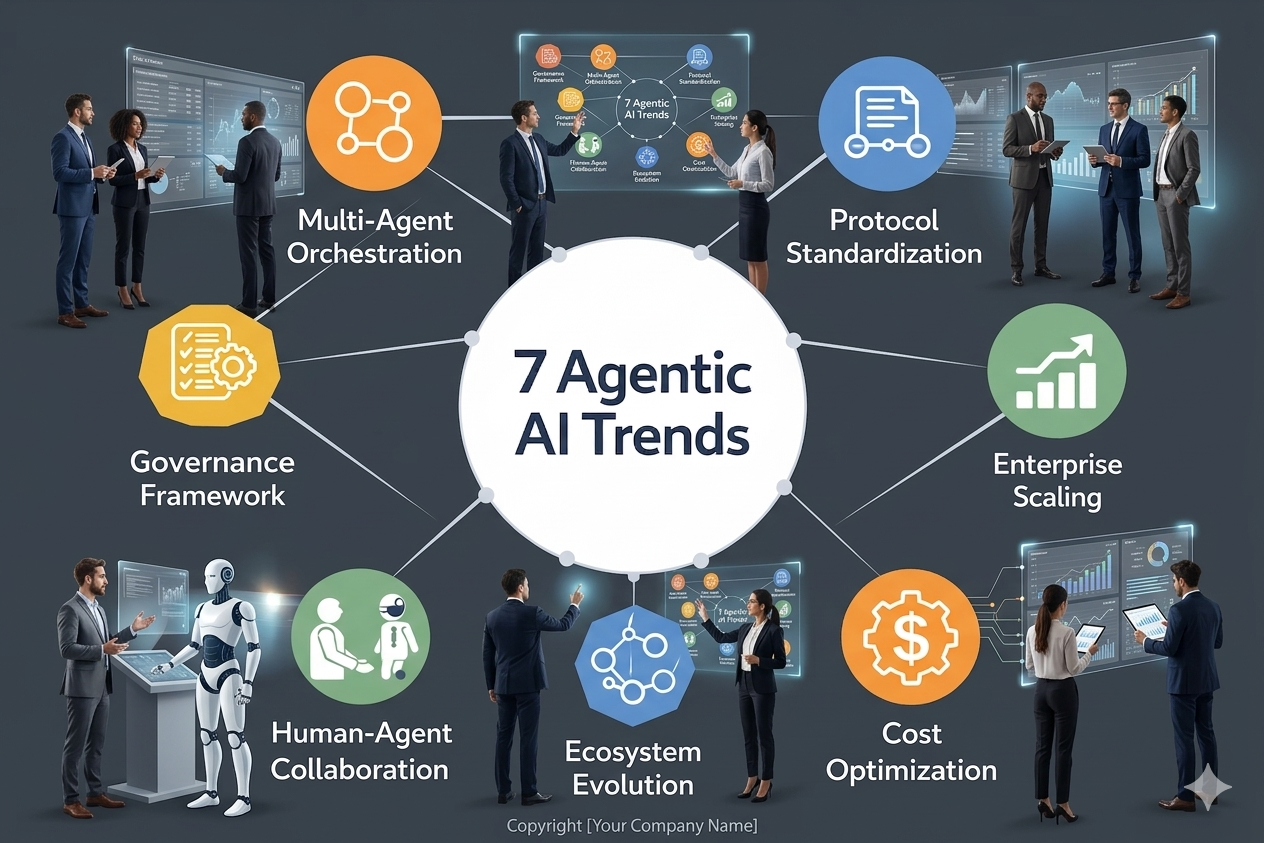
The AI agent ecosystem has grown rapidly in 2026, with businesses and individuals using autonomous AI systems to automate workflows, conduct research, write code, manage projects, and improve productivity. Below are some of the most popular AI agent tools leading the market in 2026.
OpenAI’s AI agent platform allows users to automate complex tasks through natural language instructions. These agents can perform web-based actions, conduct research, analyze information, and complete multi-step workflows with minimal supervision.
Best for:
Claude-based agents are widely used for enterprise automation, document analysis, coding assistance, and business workflows. Their large context windows make them particularly useful for handling extensive datasets and long documents.
Best for:
Google’s Gemini ecosystem integrates AI agents with productivity tools, cloud services, and search capabilities. These agents help users automate research, content generation, scheduling, and data analysis.
Best for:
Microsoft Copilot Studio enables organizations to create custom AI agents that work across business applications and workflows. It is particularly popular among enterprises already using the Microsoft ecosystem.
Best for:
CrewAI is an open-source framework designed for multi-agent collaboration. It allows developers to create teams of AI agents that work together on complex projects.
Best for:
LangChain remains one of the most widely used frameworks for building AI agents and agent-powered applications. Developers use it to connect AI models with tools, APIs, and databases.
Best for:
AutoGen is a framework developed by Microsoft for creating collaborative AI agents. It enables multiple agents to communicate and solve complex problems together.
Best for:
AgentOps focuses on monitoring, debugging, and optimizing AI agents. As AI agents become more widely deployed, tools like AgentOps help organizations track performance and reliability.
Best for:
Several platforms are leading the AI agent revolution.
| Tool | Best For | User Type |
|---|---|---|
| OpenAI Agents | Productivity & Automation | Businesses & Individuals |
| Claude Agents | Enterprise Workflows | Enterprises |
| Gemini Agents | Research & Workspace Tasks | Professionals |
| Copilot Studio | Business Automation | Enterprises |
| CrewAI | Multi-Agent Systems | Developers |
| LangChain | Agent Development | Developers |
| AutoGen | Collaborative Agents | Developers & Researchers |
| AgentOps | Monitoring & Analytics | Enterprises & Developers |
Experts believe AI agents will become increasingly capable over the next few years.
Future AI agents may:
Many analysts compare today’s AI agent market to the early days of smartphones and cloud computing.
For many businesses and professionals, the answer is yes.
AI agents can save time, automate repetitive work, and improve productivity across industries. While they are not perfect and still require human oversight, their capabilities continue to improve rapidly.
Organizations that adopt AI agents early may gain significant advantages in efficiency, innovation, and scalability.
An AI agent is an intelligent software system that can understand goals, make decisions, and perform tasks autonomously.
Chatbots mainly answer questions, while AI agents can plan, act, and complete complex workflows.
AI agents are more likely to automate repetitive tasks, allowing humans to focus on higher-value work.
Customer support, healthcare, finance, marketing, education, software development, and e-commerce are among the leading industries adopting AI agents.
Agentic AI refers to AI systems capable of independently pursuing goals, making decisions, and taking actions to achieve outcomes.
AI agents are rapidly becoming one of the most important technology innovations of 2026. Unlike traditional AI chatbots that primarily answer questions, AI agents can plan, reason, make decisions, and take actions to achieve specific goals. Their ability to automate complex workflows, interact with external tools, and work independently is transforming industries ranging from marketing and software development to healthcare and finance.
As businesses seek greater efficiency and productivity, AI agents are helping organizations reduce costs, streamline operations, and improve customer experiences. From conducting research and generating content to managing projects and analyzing data, these intelligent systems are proving to be valuable digital assistants capable of handling tasks that once required significant human effort.
The growing ecosystem of AI agent platforms and frameworks is making the technology more accessible than ever. Whether you’re a business owner looking to automate workflows, a developer building intelligent applications, or a professional seeking productivity improvements, AI agents offer powerful solutions for modern challenges.
While the technology is still evolving, its impact is already clear. AI agents represent the shift from AI that simply responds to AI that actively works on behalf of users. As capabilities continue to improve, AI agents are expected to become an essential part of everyday work and business operations, shaping the future of automation, productivity, and digital transformation for years to come.