 11
11
Artificial intelligence has evolved rapidly over the past few years. We started with AI chatbots that could answer questions, write emails, summarize documents, and generate images. Today, AI is entering a new phase where it can do much more than respond to prompts. Instead of waiting for instructions after every step, modern AI systems can plan, make decisions, use tools, and complete complex tasks with minimal human intervention.
This new generation of intelligent systems is known as Agentic AI.
Agentic AI is quickly becoming one of the biggest technology trends of 2026. Major companies such as OpenAI, Google AI MODE, Microsoft, Anthropic, NVIDIA, and Amazon are investing heavily in AI agents that can automate workflows, perform research, write code, analyze data, and even collaborate with other AI systems to achieve specific goals.
Unlike traditional AI models that simply generate responses, Agentic AI focuses on taking action. It can understand objectives, create plans, execute multiple steps, evaluate results, and adapt when something changes. This ability makes Agentic AI valuable for businesses, developers, marketers, healthcare providers, financial institutions, and countless other industries.
For example, instead of asking an AI chatbot to draft one email at a time, you could instruct an AI agent to manage an entire email campaign. The agent could research your audience, write personalized messages, schedule delivery, monitor responses, analyze performance, and recommend improvements—all with limited human supervision.
As AI technology continues to improve, Agentic AI is expected to become the foundation for intelligent digital assistants capable of handling increasingly sophisticated tasks.
In this comprehensive guide, you’ll learn:
Whether you’re a beginner, business owner, developer, or AI enthusiast, this guide will help you understand why Agentic AI is considered the next major leap in artificial intelligence.
Agentic AI is a type of artificial intelligence designed to achieve goals independently by planning tasks, making decisions, using external tools, and adapting to changing situations with minimal human guidance.
Unlike traditional AI systems that simply respond to individual prompts, Agentic AI acts more like an intelligent assistant capable of completing entire workflows from start to finish.
Instead of requiring instructions after every step, an AI agent can:
In simple terms, Agentic AI doesn’t just answer questions—it actively works toward completing objectives.
For example, imagine you ask an AI assistant:
“Plan my five-day business trip to New York.”
A traditional chatbot might provide hotel suggestions, flight options, and a sample itinerary.
An Agentic AI system, however, could:
Rather than completing a single task, the AI coordinates multiple activities to accomplish your overall goal.
This goal-oriented behavior is what separates Agentic AI from earlier generations of artificial intelligence.
The demand for intelligent automation has never been higher.
Businesses want AI MODE systems that can reduce repetitive work, improve productivity, lower operational costs, and make faster decisions. Consumers also expect digital assistants to become more capable, proactive, and personalized.
Agentic AI addresses these needs by combining several advanced AI capabilities into one autonomous system.
Some of the reasons Agentic AI is gaining momentum include:
Instead of replacing humans, Agentic AI is designed to handle repetitive, time-consuming tasks so people can focus on creativity, strategic thinking, and decision-making.
At its core, Agentic AI follows a continuous cycle of understanding, planning, acting, evaluating, and improving.
Rather than generating a single response, an AI agent continuously works toward achieving a defined objective.
A simplified workflow looks like this:
Goal → Planning → Tool Selection → Action → Observation → Evaluation → Improvement → Goal Completed
Let’s examine each stage in detail.
Every AI agent begins with a goal.
The goal may come from a user, another AI system, or an automated workflow.
Examples include:
The AI first determines exactly what success looks like before taking action.
Once the objective is understood, the AI develops a strategy.
Instead of solving everything at once, it divides large tasks into smaller, manageable steps.
For example, if the goal is to launch a blog article, the plan may include:
This planning capability allows Agentic AI to complete much more sophisticated tasks than conventional AI assistants.
After planning, the AI determines which action should happen next.
It evaluates different options, predicts possible outcomes, and selects the most effective path.
For example, if multiple sources provide conflicting information, the AI may compare reliability before choosing the best source.
Similarly, if one tool fails, the AI can select another without requiring human intervention.
This adaptive decision-making is one of the defining characteristics of Agentic AI.
Modern AI agents are not limited to generating text.
They can interact with external tools, including:
This ability dramatically expands what AI can accomplish.
For example,Instead of simply recommending a meeting time, an AI agent can access your calendar, find an available slot, send invitations, and update everyone’s schedule automatically.
After selecting the appropriate tools, the AI performs the required actions.
Depending on the objective, this may involve:
Unlike traditional AI models that stop after generating a response, Agentic AI continues working until the assigned objective is completed.
Agentic AI constantly checks whether its actions are producing the desired results.
If something changes, it can modify its approach automatically.
For example:
Instead of failing, the AI adjusts its workflow and continues moving toward the goal.
This flexibility makes Agentic AI particularly useful for dynamic business environments.
Many Agentic AI systems improve over time by learning from previous experiences, user feedback, and historical data.
Although not every AI agent continuously retrains itself, many can remember preferences, refine workflows, and optimize future decisions based on earlier interactions.
For example, if a marketing team consistently prefers concise reports with visual charts, the AI agent can automatically produce future reports in the same format.
Over time, this creates a more personalized and efficient user experience.
Agentic AI stands apart from traditional AI systems because it is designed to think, plan, and act toward achieving a goal rather than simply responding to prompts. These advanced capabilities make AI agents more autonomous, flexible, and valuable across industries.
Let’s explore the key features that define Agentic AI.
The biggest difference between Agentic AI and traditional AI is its ability to work toward a specific objective.
Instead of waiting for a new prompt after every action, an AI agent understands the final goal and determines the best sequence of steps to achieve it.
For example, if you ask an AI agent to increase your website traffic, it could:
The AI remains focused on completing the overall objective instead of treating each task as a separate request.
Complex tasks rarely involve a single action.
Agentic AI can break a large objective into smaller tasks and execute them in the correct order.
For example, creating a product launch campaign may include:
Rather than requiring manual guidance for every stage, the AI manages the workflow independently.
One of the defining characteristics of Agentic AI is its ability to make informed decisions without constant human supervision.
Instead of asking for approval after every step, the AI evaluates available information and selects the most appropriate action.
For example:
This makes AI agents particularly useful in fast-moving business environments where quick decisions are essential.
Unlike basic chatbots, Agentic AI can interact with external applications and digital tools.
These may include:
This capability enables AI agents to perform real-world actions instead of only generating text.
For example, an AI sales assistant can retrieve customer information from a CRM, draft a personalized email, send it, and update the customer’s record automatically.
Many modern AI agents include memory capabilities that allow them to remember previous interactions, preferences, and ongoing tasks.
Instead of starting every conversation from scratch, they build on earlier context.
For example, a virtual assistant might remember:
This makes interactions faster, more personalized, and significantly more productive.
Agentic AI is designed to improve its performance over time.
While not every AI agent retrains its underlying model, many can refine workflows based on user feedback, historical outcomes, and changing conditions.
For example:
The more experience the AI gains, the more effective it becomes.
Modern AI systems increasingly work alongside humans instead of replacing them.
An AI agent may also collaborate with other specialized AI agents.
For example:
This collaborative approach creates highly efficient workflows for businesses.
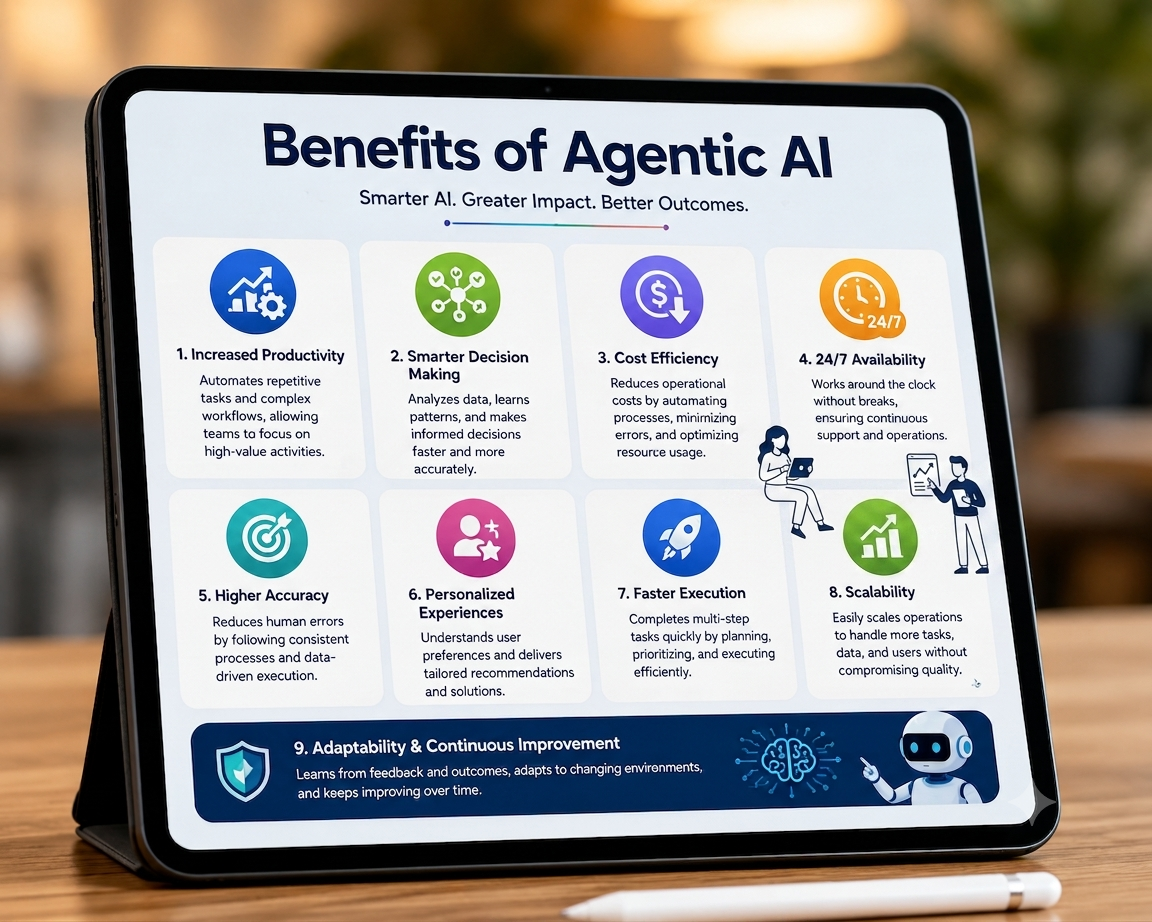
Agentic AI is transforming industries because it combines automation, intelligence, and adaptability.
Below are some of its biggest advantages.
AI agents can complete repetitive tasks much faster than humans.
Instead of spending hours organizing information, generating reports, or managing schedules, employees can focus on strategic work that requires creativity and critical thinking.
Businesses often experience significant productivity gains after implementing AI-powered automation.
Because AI agents analyze large volumes of data quickly, they can identify patterns that humans may overlook.
This leads to:
Industries such as finance, healthcare, logistics, and cybersecurity already benefit from AI-assisted decision-making.
Automating repetitive workflows reduces operational expenses.
Organizations can lower costs associated with:
Rather than replacing employees, many companies use AI agents to allow teams to focus on higher-value activities.
Unlike human workers, AI agents can operate around the clock.
This is particularly useful for:
Continuous availability improves response times and enhances customer satisfaction.
Agentic AI follows predefined workflows consistently.
It reduces errors in repetitive tasks such as:
While human oversight remains important, AI significantly improves consistency.
AI agents can analyze customer behavior and preferences to deliver personalized recommendations.
Examples include:
Personalization improves engagement, conversions, and customer loyalty.
Organizations using AI agents often accelerate routine processes.
Examples include:
This allows businesses to scale operations more efficiently.
Agentic AI is already being used across multiple industries. Here are some practical examples.
An AI customer service agent can:
Instead of simply generating responses, the AI actively manages the support workflow.
Healthcare providers use AI agents to:
These systems help healthcare professionals save time while improving patient care.
AI coding agents assist developers by:
Developers remain in control while AI handles repetitive programming tasks.
Marketing teams increasingly rely on AI agents to:
This allows marketers to focus on strategy and creativity rather than manual execution.
Financial institutions use Agentic AI for:
AI can process millions of transactions far faster than human analysts.
Security teams use AI agents to:
Because cyberattacks occur continuously, AI agents provide around-the-clock protection.
Online retailers use Agentic AI to:
This improves operational efficiency while enhancing the shopping experience.
| Industry | Common Applications |
|---|---|
| Healthcare | Diagnosis support, patient monitoring, documentation |
| Finance | Fraud detection, forecasting, risk analysis |
| Marketing | Content creation, SEO, campaign automation |
| Education | Personalized learning, tutoring, grading |
| Retail | Product recommendations, inventory management |
| Manufacturing | Predictive maintenance, quality control |
| Cybersecurity | Threat detection, automated response |
| Software Development | Coding assistance, testing, debugging |
| Human Resources | Resume screening, interview scheduling, onboarding |
| Customer Service | AI support agents, ticket routing, live assistance |
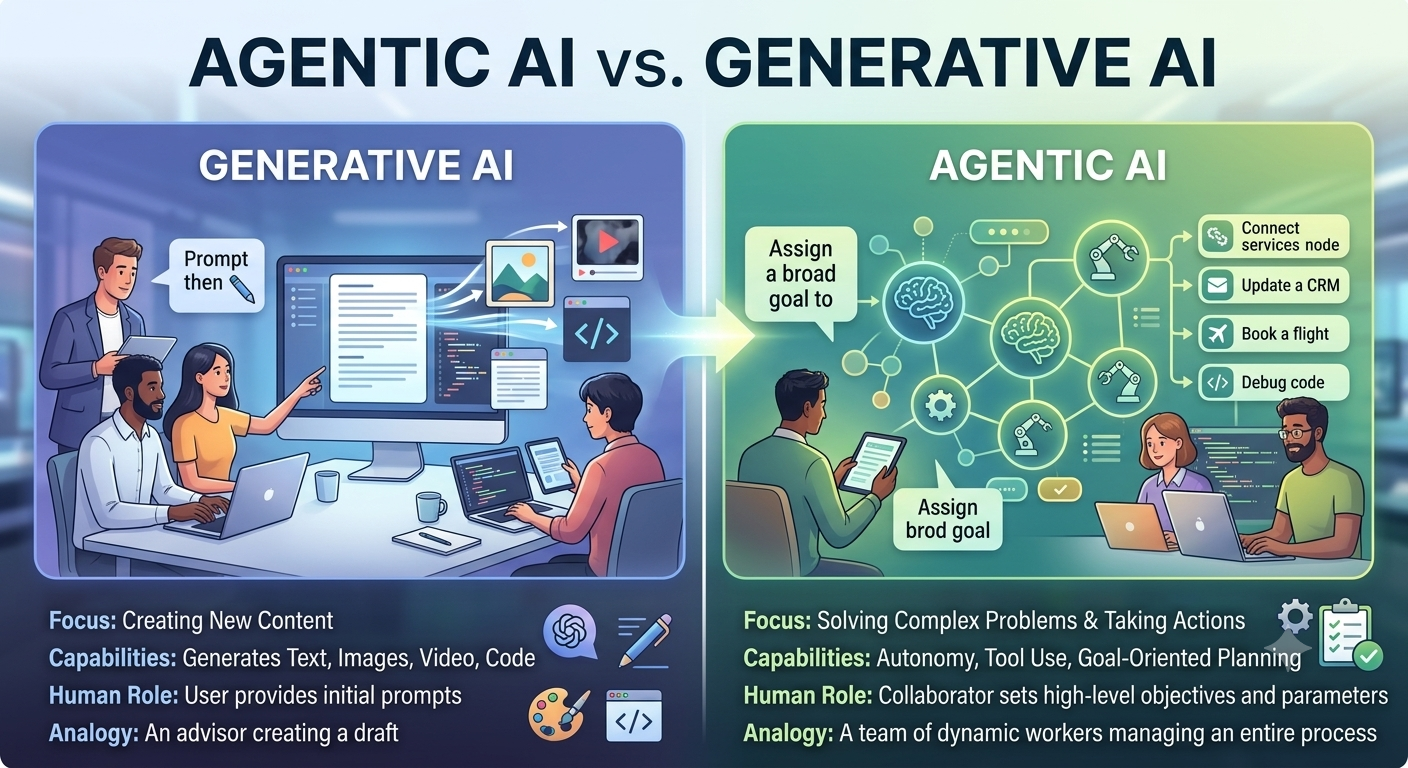
Although the terms Agentic AI and Generative AI are often used together, they represent different concepts. Understanding the distinction is important because they solve different types of problems.
Generative AI focuses on creating content, while Agentic AI focuses on achieving goals by planning and executing tasks.
For example, if you ask a Generative AI chatbot to write a blog post, it generates the content and stops. If you ask an Agentic AI system to publish a successful blog article, it can research keywords, analyze competitors, create an outline, write the article, optimize it for SEO, generate images, schedule publication, and monitor performance.
In many cases, Agentic AI actually uses Generative AI as one part of its workflow.
| Feature | Agentic AI | Generative AI |
|---|---|---|
| Primary Purpose | Achieve goals and complete workflows | Generate content based on prompts |
| Planning | ✔ Yes | ✘ Limited |
| Multi-Step Execution | ✔ Yes | ✘ Usually No |
| Autonomous Decisions | ✔ Yes | Limited |
| Tool Usage | ✔ Uses APIs, browsers, software, and databases | Usually limited without integrations |
| Memory | Often includes long-term memory | Usually session-based |
| Reasoning | Advanced multi-step reasoning | Primarily prompt-based reasoning |
| Human Supervision | Minimal | Frequent |
| Best For | Workflow automation, business operations, research | Writing, coding, brainstorming, summarization |
| Example | AI research assistant managing an entire project | AI writing a blog post or answering questions |
Agentic AI is ideal when the objective involves multiple connected tasks.
Examples include:
Instead of manually coordinating each step, the AI agent handles the complete workflow.
Generative AI remains an excellent choice for individual creative and knowledge-based tasks.
It works well for:
For these standalone tasks, a traditional AI assistant is often faster and simpler.
The rapid growth of AI has led to the development of powerful AI agent platforms. Some focus on productivity, while others specialize in coding, research, automation, or enterprise workflows.
Below are some of the most popular Agentic AI tools available in 2026.
Modern versions of ChatGPT support advanced agent capabilities that go far beyond answering questions.
Key capabilities include:
Best for:
Google Gemini combines advanced reasoning with Google’s ecosystem.
Key features:
Ideal for organizations already using Google’s services.
Claude is known for handling long documents and complex reasoning tasks.
Popular use cases include:
Its large context window makes it particularly useful for enterprise workflows.
Microsoft Copilot integrates AI into everyday productivity software.
Capabilities include:
Businesses using Microsoft 365 benefit from seamless AI-powered automation.
AutoGen is an open-source framework designed for creating multiple AI agents that collaborate with one another.
Developers use AutoGen to build systems where different AI agents perform specialized tasks such as planning, coding, reviewing, and testing.
CrewAI enables developers to build teams of AI agents with assigned roles.
For example:
Each agent performs its own responsibilities while working toward a common objective.
LangGraph allows developers to build advanced AI workflows using graph-based logic.
It supports:
Many enterprise AI applications are now being built using frameworks like LangGraph.
Devin AI focuses on software engineering.
It can:
Rather than generating isolated code snippets, it contributes to complete development workflows.
| Tool | Best For |
|---|---|
| ChatGPT | General productivity, research, writing, coding |
| Google Gemini | Google Workspace users and research |
| Claude | Long documents and advanced reasoning |
| Microsoft Copilot | Microsoft 365 productivity |
| CrewAI | Multi-agent business automation |
| AutoGen | AI agent development |
| LangGraph | Enterprise AI workflows |
| Devin AI | Software development |
Each platform offers unique strengths, and many organizations combine multiple tools depending on their requirements.
Despite its impressive capabilities, Agentic AI is still evolving.
Organizations should understand its limitations before deploying AI agents at scale.
AI agents may occasionally generate incorrect or misleading information.
If inaccurate data is used during planning, the final outcome can also be incorrect.
Human verification remains important for high-risk decisions.
AI agents often access:
Organizations must implement strong security measures, access controls, and encryption to protect sensitive information.
As AI agents become more autonomous, ethical questions continue to grow.
Examples include:
Businesses should establish governance policies for AI systems.
Building enterprise-grade AI agents may require:
Although costs continue to decrease, advanced AI automation can still represent a significant investment.
AI agents make decisions based on available information.
Poor-quality, outdated, or biased data often leads to poor outcomes.
Maintaining clean and reliable datasets is essential for successful AI deployment.
Despite increasing autonomy, Agentic AI should not operate entirely without supervision.
Humans remain responsible for:
The most effective organizations treat AI as a collaborative partner rather than a complete replacement for human expertise.
To maximize success with AI agents, consider these recommendations:
Following these best practices helps organizations deploy Agentic AI safely and effectively.
Agentic AI is still in its early stages, but its growth is accelerating rapidly. Over the next few years, AI agents are expected to become more autonomous, reliable, and deeply integrated into both business operations and everyday life.
Instead of using separate AI tools for writing, coding, research, scheduling, and data analysis, people will increasingly rely on intelligent AI agents that can coordinate all of these tasks within a single workflow. You can also check GEO.
Future AI assistants won’t simply answer questions—they’ll proactively manage your daily tasks.
Imagine telling your AI assistant:
“Prepare my quarterly marketing report.”
The AI could automatically:
Instead of helping with one task, it completes the entire workflow.
One AI agent may no longer work alone.
Businesses are already experimenting with teams of specialized AI agents where each has a dedicated responsibility.
Example:
Together, these AI agents can complete projects much faster than a single assistant.
Future AI models will improve their ability to:
This will significantly increase their usefulness in industries such as healthcare, finance, engineering, education, and scientific research.
Businesses are expected to adopt Agentic AI across nearly every department.
Examples include:
Rather than replacing employees, AI agents will act as intelligent digital teammates that automate repetitive work and improve productivity.
Future AI agents will better understand individual users by remembering:
This long-term memory will make interactions more personalized and efficient.
As AI agents become more capable, governments and technology companies will continue developing regulations and safety standards.
Future Agentic AI systems are expected to include:
Responsible AI development will be essential for building trust among businesses and consumers.
Agentic AI is an advanced type of artificial intelligence that can plan, make decisions, use tools, and complete tasks with minimal human supervision. Instead of simply responding to prompts, it works toward achieving specific goals.
Generative AI creates content such as text, images, code, or videos based on user prompts. Agentic AI goes further by planning tasks, making decisions, using external tools, and executing complete workflows.
No. Agentic AI is designed to assist humans rather than completely replace them. It automates repetitive tasks, allowing people to focus on creativity, strategic thinking, and complex decision-making.
Many industries are already adopting Agentic AI, including:
Agentic AI can be safe when developed and deployed responsibly. Organizations should implement strong security measures, protect sensitive data, monitor AI decisions, and keep humans involved in high-impact decisions.
Examples include:
Yes. Industry experts expect Agentic AI to become a core technology for businesses, software platforms, and digital assistants over the next several years as AI models become more capable and reliable.
Agentic AI represents the next major evolution of artificial intelligence.
Unlike traditional AI systems that simply generate responses, Agentic AI can understand goals, create plans, make decisions, use digital tools, and complete complex workflows with minimal human guidance.
Its ability to combine reasoning, planning, memory, and automation is transforming how businesses operate and how individuals interact with technology.
From software development and healthcare to finance, education, and marketing, organizations are already using AI agents to improve productivity, reduce costs, and automate repetitive work.
However, the future of Agentic AI depends on responsible implementation. Human oversight, ethical governance, privacy protection, and transparency will remain essential as AI systems become increasingly autonomous.
As the technology continues to evolve, businesses and professionals who understand and adopt Agentic AI early will be better positioned to improve efficiency, innovate faster, and remain competitive in an AI-driven world.
Whether you’re a business owner, developer, marketer, or simply curious about the future of artificial intelligence, learning how Agentic AI works today will prepare you for the intelligent systems of tomorrow.